WSW warehouses an extensive inventory of high-grade, straight,
cylindrically-shaped compression springs in the world. All the springs found in
this section of the catalog are fabricated from round wire. The energy storage
capacity is greater for round-wire compression springs than for rectangular-wire
compression springs. Rectangular wire is sometimes employed to reduce the solid
(totally compressed) height or increase the space efficiency of the design.
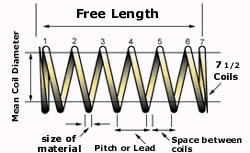
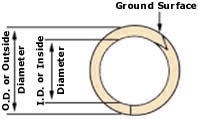
- Turn to the inventory page with the desired
outside diameter (O.D.). Outside diameters increase as page numbers increase
and are found in the left column of the page.
- Next, find the length or rate (strength) you
require. These, too, are normally in increasing order. Spring
rate is the load (pounds) it takes to deflect (compress) the spring one
theoretical inch, i.e., if the rate = 40 Lbs/In., it would take 10 pounds to
deflect it 1/4 inch, or 80 pounds for 2 inches, etc..
- If the length or rate is not known but the
installed working length (W.L.) is, then select a spring - say 30% longer -
than the W.L. You must know the load at the W.L.. Just subtract the W.L.
from the spring's selected free length and multiply by its rate to compare
with your required value.
- If the load required is not obtained, select
a new candidate with either and increase or decrease in rate (strenght) or
free length.
- Be certain that the tabulated solid length
(completely compressed) for your candidate spring indicates enough room for
deflection and, also, that the deflection is not significantly greater than
the tabulated "Maximum Suggested" for stress reasons.
Note: If the spring needed for your application cannot be found in our catalog inventory, we can fabricate it
for you. Often, there is no cost increase for this service as we have low
quantity requirements.
|
